
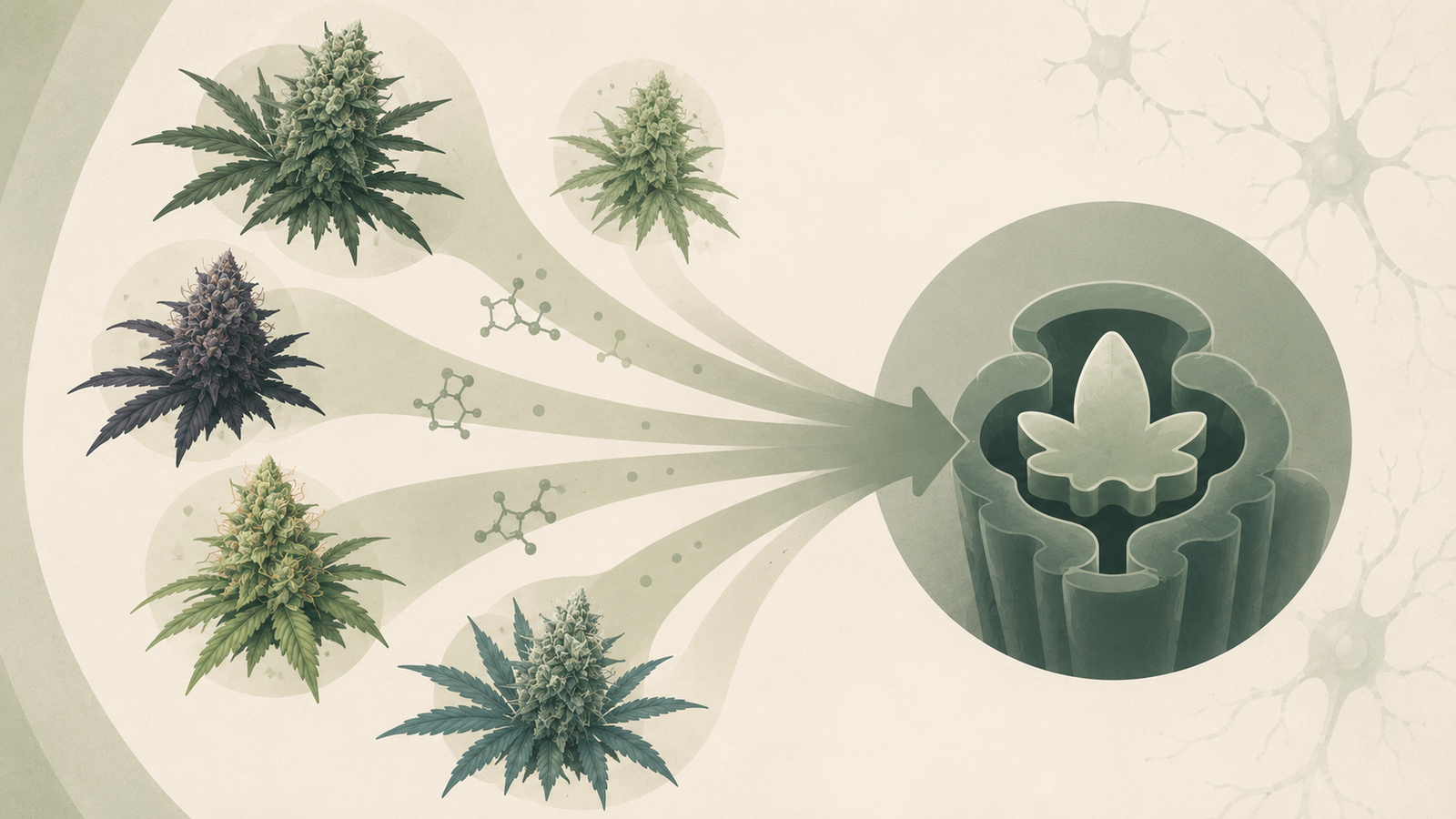
Does rotating strains lower tolerance? No, not in any real sense. Your tolerance is built to THC, and every cannabis strain, sativa or indica, gets you high through the same THC acting on the same CB1 receptors. That is called cross-tolerance: because the mechanism is shared, switching from one strain to another does not reset the receptors that drive your tolerance in the first place.
What strain rotation can do is change the terpene and cannabinoid mix, and therefore the character of your high. A new strain can feel different, even feel stronger for a session or two. But feeling different is not the same as lowering tolerance. Below, we separate the novelty effect from the actual biology, and explain the one thing that genuinely moves the needle.
Why tolerance is to THC, not to a specific strain
To see why rotation falls short, start with how tolerance forms. THC gets you high by binding to CB1 receptors in your brain. Use cannabis regularly and your brain adapts by pulling those receptors off the cell surface, a process called downregulation. Fewer available receptors means the same dose does less, which is the core of a rising tolerance.
Here is the key part: that adaptation is a response to THC itself, not to any particular strain, brand, or growing method. A boutique sativa and a bargain indica both deliver THC, and THC is what your CB1 receptors are downregulating against. So when you rotate strains, you are still feeding the same receptors the same molecule they have already adapted to. For the full picture of how this builds, see our guide to what a high THC tolerance actually is.
What is cross-tolerance, and why does it matter here?
Cross-tolerance means that building a tolerance to one substance also blunts your response to another that works the same way. Because all THC-dominant strains act on CB1 receptors through THC, they are effectively interchangeable as far as your tolerance is concerned.
Think of your CB1 receptors like parking spots that THC pulls into. Downregulation removes some of the spots. It does not matter whether the car is a sativa or an indica, a flower or a dab, or last month’s strain versus this week’s new jar, the number of available spots is the same either way. That is why switching strains cannot side-step tolerance: there is no separate set of receptors waiting fresh for a different strain.
The one caveat worth naming honestly: cannabis delivery format changes the experience more than strain name does. Edibles are metabolized differently than smoke, which is why your edible and inhaled tolerances can feel out of step, something we break down in edible vs smoking tolerance. But that is about how THC reaches you, not about escaping cross-tolerance.
Do sativa and indica have different tolerances?
Not in any meaningful, separate way. You do not build one tolerance to sativa and a distinct tolerance to indica that you can toggle between. The tolerance that matters is to THC, and both categories deliver THC to the same receptors.
The sativa-versus-indica labels mostly describe expected effects, energizing versus relaxing, that are shaped by the strain’s terpene profile and cannabinoid ratios, not by a different tolerance pathway. Two strains can feel very different while affecting your CB1 receptors in the same fundamental way. So a sativa may suit a daytime session and an indica an evening one, but neither is quietly lowering your tolerance while the other builds it.
Why does a new strain feel stronger, then?
Because novelty and chemistry can both change the experience without changing your tolerance. A few things are usually going on when a fresh strain hits harder.
- Actual potency differences. The new strain may simply contain more THC than your usual, so you are taking a bigger dose without realizing it.
- A different terpene and cannabinoid mix. Shifting ratios can change the texture of the high, more heady, more sedating, more clear, which reads as new even at a similar THC level.
- The novelty effect. A different taste, aroma, and head-feel grabs your attention and can make a familiar-strength high feel notably fresh.
All of this is real and worth enjoying. But notice what it is not: it is not your CB1 receptors coming back online. A strain that feels stronger for a session or two is delivering a novel or higher-THC experience, not resetting the downregulation underneath your tolerance.
What rotating strains can genuinely do
Rotation is not useless, it is just misunderstood. Used with intent, switching strains can:
- Change the character of your high by shifting terpene and cannabinoid ratios, which is genuinely valuable for matching a strain to your mood or time of day.
- Refresh perceived effect through novelty, so a session feels more engaging even if the underlying potency is similar.
- Lower your THC load, if you deliberately rotate toward lower-THC strains. This is the one route where rotation touches tolerance, and it works only because you are reducing THC, not because you switched strains.
That last point is the honest takeaway. Rotating to a lower-THC strain can slow the dose-escalation that pushes tolerance up, in the same way any dose reduction would. The lever is always THC exposure. If you want a fuller playbook, see how to lower weed tolerance without quitting.
The only thing that actually lowers tolerance
Reducing THC exposure is what lets your CB1 receptors recover. The reassuring news is that this adaptation is reversible. Hirvonen et al., 2012, published in Molecular Psychiatry, scanned the brains of chronic daily cannabis users and found their CB1 receptor availability returned toward normal after roughly four weeks of monitored abstinence.
Cannabis science is still developing overall, as the National Institute on Drug Abuse (NIDA) notes, but the tolerance picture is fairly consistent: it is driven by THC and it recovers when THC exposure drops. Rotating strains, on its own, does not lower that exposure. A real reset comes from a tolerance break, a genuine taper, or another approach that reduces how much THC reaches your receptors. Our guide on how to reset cannabis tolerance walks through the options.
Where a targeted reset approach fits
If you want something more targeted than swapping jars, but you are not eager for a multi-week break, one option is built specifically around CB1 occupancy. Olivetol, the compound behind the supplement Undoo Reset, is marketed to influence receptor occupancy over a short protocol, aimed at refreshing tolerance without a long abstinence period.
Be clear-eyed about the evidence: the olivetol composition patent describes informal volunteer reports, not clinical trials, so treat it as a proposed approach rather than proven science. It is a different tool than strain rotation, and unlike rotation, it is aimed directly at the tolerance mechanism instead of the flavor.
Undoo Reset is a dietary supplement. It is not intended to diagnose, treat, cure, or prevent any disease, and it is not a way to pass a drug test. This page contains affiliate links. Cannabis laws vary by location, follow yours; 21+ only. If you are pregnant, nursing, on medication, or managing a health condition, check with a healthcare provider first.
Frequently asked questions
Does rotating strains lower tolerance?
No. Tolerance is built to THC, and every strain acts on the same CB1 receptors through THC, which creates cross-tolerance. Switching strains does not reset those receptors. The only way rotation touches tolerance is if you deliberately move to lower-THC strains, which helps because it reduces your THC dose, not because the strain changed.
Does switching strains reset your tolerance?
No. A reset happens when your CB1 receptors recover, which is driven by reducing THC exposure over time, not by trying a different strain. Research links meaningful recovery to roughly four weeks of abstinence for heavy users. A new strain can feel fresh, but that novelty is not a receptor reset.
Do sativa and indica have different tolerances?
Not in a separate, toggle-able way. You do not build one tolerance to sativa and another to indica. Both deliver THC to the same receptors, so the tolerance that matters is shared. The sativa and indica labels describe expected effects shaped by terpenes, not a different tolerance pathway.
Why does a new strain feel stronger?
Usually one of three reasons: the new strain actually contains more THC, its different terpene and cannabinoid mix changes the character of the high, or plain novelty makes a familiar-strength high feel fresh. None of these mean your tolerance dropped, they mean the experience changed.
The honest bottom line
Rotating strains is a great way to keep cannabis interesting and match effects to your mood, but it is not a tolerance reset. Because of cross-tolerance, every strain leans on the same CB1 receptors, so the only real lever is reducing THC exposure. If you want an actual reset without a long break, read how Undoo Reset works and decide what fits your routine.