
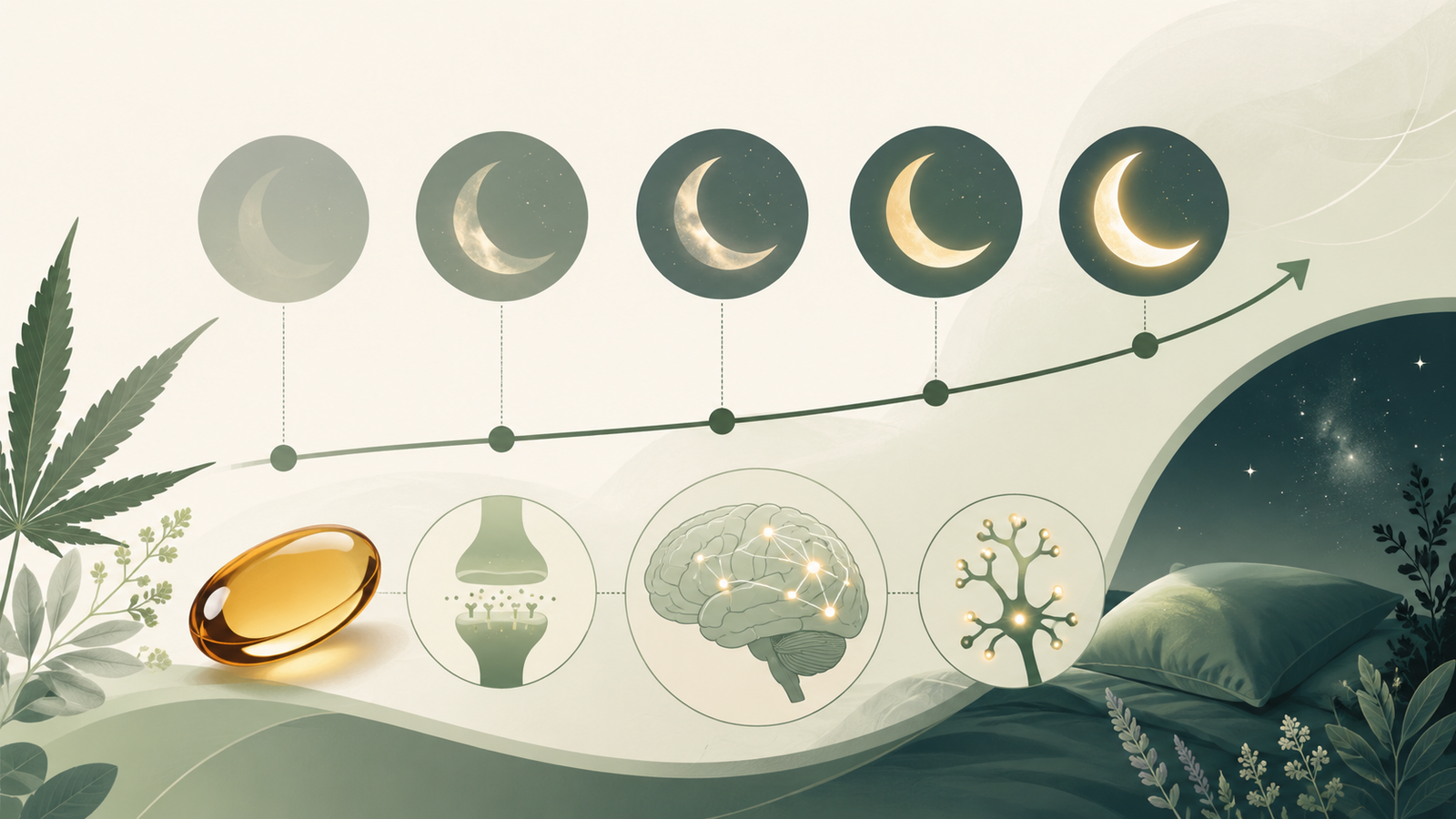
Yes, you can lower your weed tolerance without quitting. The most reliable methods are to cut your effective dose, drop the potency, add CBD, space your sessions further apart, and take short planned mini-breaks — all of which give your CB1 receptors room to recover while you keep using. And if you want a faster reset without a long abstinence break, an olivetol-based option like Undoo Reset is marketed as a 5-night alternative.
Part of our guide on how to reset cannabis tolerance.
Let’s break down why tolerance climbs, then walk through each method so you can pick what fits your routine.
Why does weed tolerance build up?
Tolerance is a normal physiological adaptation, not a character flaw. When THC repeatedly binds to your CB1 receptors, your brain responds by pulling some of those receptors out of circulation — a process called downregulation. Fewer available receptors means the same dose lands softer, so you reach for more to feel the same effect.
The encouraging part: it’s usually reversible. A brain-imaging study by Hirvonen et al. (2012) in Molecular Psychiatry found that CB1 receptor density in chronic cannabis users returned toward normal after roughly four weeks of abstinence. That’s the mechanism behind a classic tolerance break — but the same principle, receptor recovery, is what every method below is quietly working toward. For a fuller picture, see our guide to what cannabis tolerance is, its causes and timeline.
Cut your effective dose (microdose)
The single biggest lever is how much THC you actually take in. If you can get the effect you want from less, your receptors face less pressure to downregulate. Practically, that means finding the smallest amount that still works and stopping there instead of topping up out of habit.
- Take one hit and wait. Give flower or a vape a full 10–15 minutes, and edibles a full 1–2 hours, before deciding you need more.
- Measure edibles. Move to a known low dose (say 2.5–5 mg) instead of eyeballing homemade portions.
- Track it. Even a rough log of how much you use and how high you get makes creeping dose escalation visible.
Drop the potency
Dabs and high-THC concentrates flood your receptors far harder than flower does, which tends to push tolerance up faster. Stepping down the concentration — from concentrates to flower, or from high-THC strains to lower-THC ones — lowers the total THC hitting your CB1 receptors per session without asking you to stop.
Think of it as choosing a gentler input. You’re still using; you’re just not maxing out the system every time.
Space out your sessions
Frequency matters as much as amount. Receptors need time between exposures to recycle back to the surface, so widening the gap between sessions gives them that window. If you’re an all-day, every-day user, even shifting to evenings-only, or skipping a day here and there, changes the math.
A useful reframe: you’re not depriving yourself, you’re spacing your doses so each one lands harder. Many daily users find that a single evening session after a full day off simply works better than constant grazing.
Add CBD to slow dose escalation
CBD doesn’t bind CB1 the way THC does, and it isn’t a tolerance eraser. But some users pair CBD with THC to take the edge off and reduce the urge to keep bumping the THC dose up. If it helps you hold a lower THC amount, it’s indirectly helping your receptors — not by resetting them, but by easing the escalation that drives tolerance in the first place.
Treat this as a personal-experiment tool, not a guarantee. The evidence here is mixed and individual, so notice what actually changes for you.
Take short, planned mini-breaks
You don’t have to disappear for a month to get value from abstinence. Even a weekend or a couple of scheduled days off lets some receptor recovery begin, and it’s a lot easier to commit to than a full T-break. Stacked over time, regular mini-breaks keep tolerance from running away.
If you’re weighing how long to step away for, our breakdown of how long a tolerance break should be covers what different lengths realistically do. Longer breaks reset more, but shorter, repeatable ones you’ll actually follow beat an ambitious break you abandon on day two.
Support it with lifestyle basics
None of these are magic, but they support a healthier endocannabinoid system alongside the methods above. Regular exercise, decent sleep, and staying hydrated are all reasonable, low-risk habits. The National Institute on Drug Abuse (NIDA) is a solid neutral source if you want to read more about how cannabis affects the brain and body.
Want a faster reset? The olivetol option
Every method so far trades time for tolerance: they work gradually, or ask for at least a short break. If you’d rather compress that into a few nights without a long abstinence stretch, there’s another route — olivetol, the active ingredient in Undoo Reset.
According to its composition patent (US 10,265,277 B2), olivetol is proposed to occupy or interact with CB1 receptors in a way designed to help restore sensitivity — the idea being to change receptor occupancy rather than asking you to stop using for weeks. Undoo’s training guide suggests a protocol of 2 softgels with 12–16 oz of water before bed for 5 nights, and no more than 6 in 24 hours. Worth being straight about the evidence: the patent’s supporting reports come from informal volunteer feedback, not blinded clinical trials, so this is proposed and anecdotal rather than proven. Our 5-day tolerance reset walkthrough covers the routine in detail.
The honest trade-off is time versus certainty. A traditional tolerance break has decades of receptor-recovery science behind it but costs you weeks; the olivetol approach is designed to be faster but rests on less rigorous evidence. If you want to see them side by side, read olivetol vs. a tolerance break before deciding.
Undoo Reset is a dietary supplement. It is not intended to diagnose, treat, cure, or prevent any disease, and it is not a way to pass a drug test. This page contains affiliate links. 21+ only; follow your local laws, and check with a healthcare provider if you’re pregnant, nursing, on medication, or managing a health condition.
Frequently asked questions
Can you lower your tolerance without quitting?
Yes. Cutting your effective dose, dropping potency, spacing sessions, adding CBD, and taking short mini-breaks all reduce the pressure on your CB1 receptors while you keep using. You won’t reset as completely as a full multi-week break, but you can meaningfully slow and often reverse tolerance creep without stopping entirely.
How do I lower my tolerance fast?
The fastest proven route is abstinence, since receptor recovery is time-dependent — but even a few days off helps. If you want speed without a long break, the olivetol-based Undoo Reset markets a 5-night protocol as a faster alternative. Just note its evidence is anecdotal and patent-based, not clinically proven.
Does lowering my dose reset tolerance?
Lowering your dose won’t fully reset tolerance the way weeks of abstinence can, but it slows and gradually reverses the buildup. Less THC hitting your receptors means less downregulation over time, so your baseline sensitivity tends to drift back — slower than a break, but without stopping.
Can Undoo Reset lower tolerance without a break?
Undoo Reset is marketed as a 5-night, olivetol-based way to reset tolerance without a long abstinence break, based on its composition patent’s proposed mechanism of changing receptor occupancy. It’s a dietary supplement, and the supporting reports are informal rather than from clinical trials, so results aren’t guaranteed. Some users report noticeable effects; your mileage may vary.
The bottom line
You didn’t break anything — your endocannabinoid system adapted, and it can adapt back. Start with the lowest-effort change that fits your routine, whether that’s trimming your dose, dropping potency, or spacing sessions, and stack from there. And if you’d rather skip the long wait, see how the olivetol reset works and decide whether the 5-night approach fits you.