
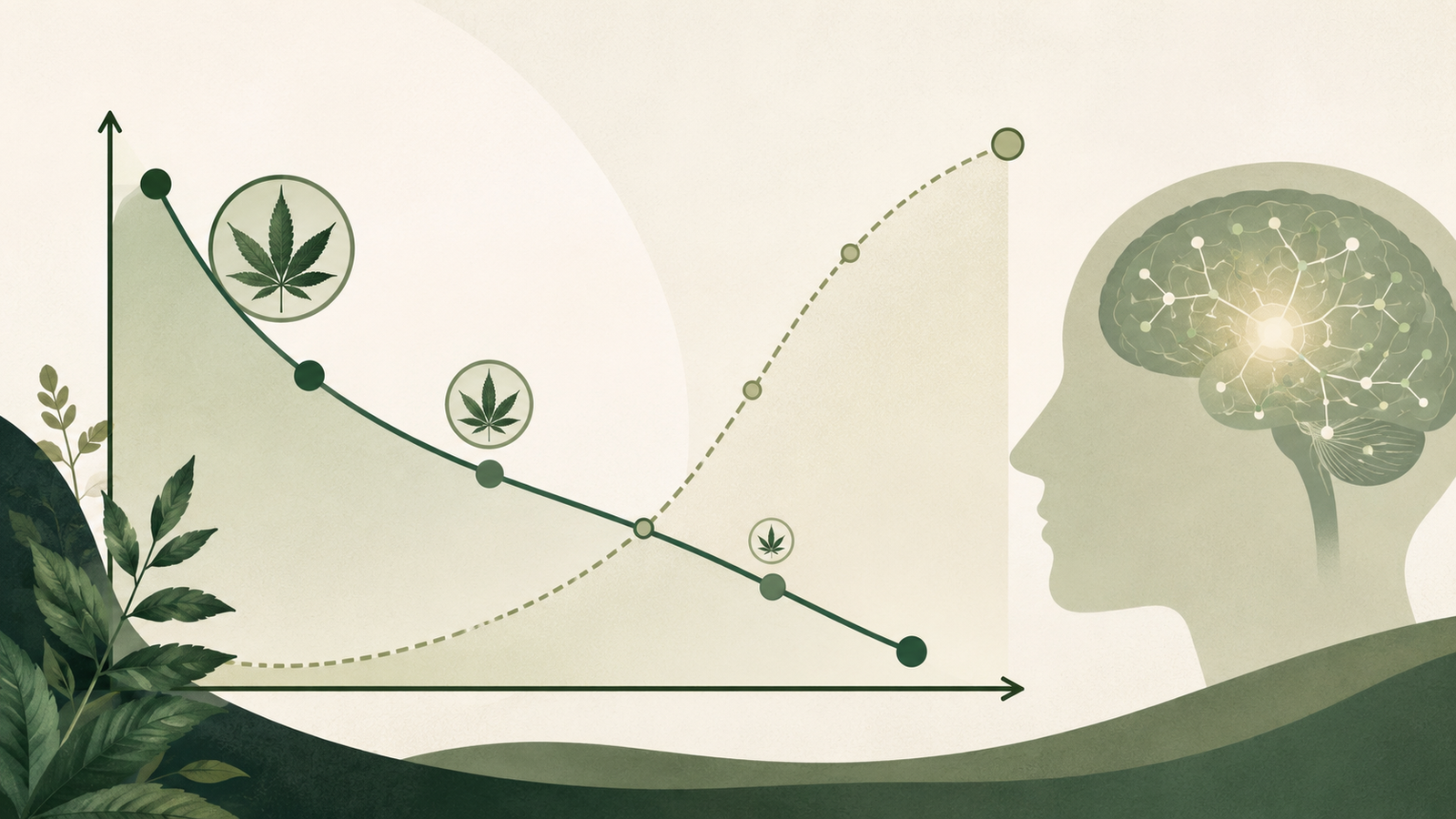
Cannabis tolerance is what happens when the same dose that used to work starts feeling… polite. The product didn’t suddenly “stop working.” Your body got better at predicting and dampening the signal.
In plain terms: cannabis tolerance is a decreased response to the same amount of THC after repeated exposure. It’s common, it’s not a moral failing, and it’s usually reversible. The useful part is understanding what drives it, how to recognize it, and what a realistic timeline looks like for building it and dialing it back.
This guide is the hub of everything we cover. Along the way we’ll link you to deeper articles on how long a tolerance break should be, how to lower your tolerance without quitting, and the science of olivetol.
Understanding cannabis tolerance
What is cannabis tolerance?
Cannabis tolerance (used interchangeably with THC tolerance or “weed tolerance”) is a form of physiological adaptation where repeated THC use leads to reduced effects at the same dose.
There are two layers to it:
What you notice: you need more THC to feel the same high, the high doesn’t last as long, or the experience feels “flatter.”
What’s happening biologically: THC interacts with your endocannabinoid system (ECS), especially CB1 receptors concentrated in the brain and central nervous system. Over time, repeated activation leads to receptor desensitization (less responsive signaling) and downregulation (fewer receptors available) — which reduces perceived effects. Brain-imaging research has directly measured this CB1 downregulation in daily cannabis users (Hirvonen et al., 2012, Molecular Psychiatry).
Why does cannabis tolerance happen?
Tolerance is driven by neuroadaptation: your nervous system learns the pattern and compensates. The main mechanisms:
- CB1 receptor downregulation from frequent activation
- CB1 receptor desensitization (the receptor still exists, but responds less)
- Pharmacodynamic adaptation (your brain reduces the impact of the same chemical “message”)
- Metabolic factors in some people (how quickly THC is processed, edible conversion, etc.)
Short-term heavy use can produce noticeable tolerance within days. Longer periods of frequent use can make tolerance feel “sticky,” with a slower return to baseline. Some people also start with a naturally higher tolerance before they build any at all.
Signs and symptoms of THC tolerance
Here’s what tolerance looks like in real life:
- Needing higher doses to reach the same effect
- Effects wear off faster than they used to
- Reduced euphoria or reduced “lift”
- Relaxation and sleep benefits feel weaker even at familiar doses
- “Chasing the old high”: one more hit, one more edible, one more cart pull
- Edibles feel inconsistent even at the same dose
A useful mental check: tolerance often shows up as a compressed range. Your “low dose” feels like nothing, your “normal dose” feels like low, and your “high dose” feels like normal. Not sure whether you’ve crossed the line? See what counts as a high THC tolerance and why your tolerance may be so high.
Tolerance vs “bad product”
Not every disappointing session is tolerance. Before you declare your CB1 receptors “dead,” rule out the usual suspects: mislabeled potency, sleep debt and stress, route of administration (inhaling hits fast and fades fast; edibles are slower and more variable), and a shifted comparison point from daily use. Quick gut test: take two days off, then try your usual dose. If effects noticeably rebound, tolerance was a major factor.
How long does it take to develop cannabis tolerance?
There isn’t one timeline, but there are patterns:
- Daily users: noticeable tolerance can build in 1–2 weeks, sometimes sooner with high-potency THC.
- Near-daily users (4–6 days/week): tolerance often creeps in across 2–4 weeks.
- Weekend or occasional users: tolerance may be minimal unless doses are very high.
What speeds it up: high-potency THC (concentrates, strong vapes), multiple sessions per day, an escalating dose pattern, and low variety. What slows it down: lower doses, fewer sessions per week, intentional spacing, and rotating product types. For the full breakdown, see how long it takes to build a weed tolerance.
How long does it take to reset cannabis tolerance?
Resetting tolerance is the reverse process: reduce THC exposure long enough for receptor sensitivity and signaling to rebound. Two realities to keep in mind — your experience can improve before your biology fully returns to baseline, and “reset” isn’t binary. It’s a spectrum of regained sensitivity.
The strongest evidence comes from brain-imaging work: in chronic daily smokers, CB1 receptor density returned to normal after about four weeks of monitored abstinence (Hirvonen et al., 2012). Most people notice meaningful improvement well before that.
The tolerance break (T-break)
A tolerance break is the most straightforward method: reduce THC exposure for a defined period (see our complete cannabis tolerance break guide). Common timeframes:
- 48 hours: often enough for light-to-moderate users to notice a bump — more on whether a 2-day break does anything
- 7 days: a solid reset for many regular users
- 14–21 days: where heavier daily users report bigger changes
- 30 days: a common “full reset” target, though results vary
Not sure how long you need? Our tolerance break length guide and day-by-day tolerance break chart break it down, and the side effects guide covers what to expect.
Resetting without a long break
Not everyone wants two weeks off. That’s the gap Undoo Reset is marketed to fill: an olivetol-based, non-intoxicating supplement designed to support a faster return of sensitivity without a long abstinence period. Its budtender guide describes a 5-night protocol. We cover how that’s designed to work — and what the evidence does and doesn’t show — in how Undoo Reset works and the 5-day reset explained.
Undoo Reset is a dietary supplement, not an FDA-approved drug. It is not intended to diagnose, treat, cure, or prevent any disease, and it is not a way to pass a drug test. This page contains affiliate links.
Can you prevent cannabis tolerance?
You can’t prevent adaptation entirely if you use frequently, but you can slow it down: microdose (lower your effective dose), space out sessions, rotate products and cannabinoid ratios, add CBD-rich products to reduce dose escalation, and schedule predictable mini-breaks. For the full playbook, see how to lower your weed tolerance without quitting.
Cannabis tolerance by type
THC tolerance is the main event — THC binds strongly to CB1 receptors, which is why tolerance is most visible here. Edible tolerance can feel different: edibles are converted into 11-hydroxy-THC, which is stronger and longer-lasting, so regular edible use produces its own pattern (see edible tolerance). CBD tolerance is debated and usually less obvious, since CBD doesn’t create the same “high” feedback loop.
Frequently asked questions
Can you fully reset your weed tolerance?
Yes. Tolerance is a reversible adaptation. Brain-imaging research found CB1 receptor levels returned to normal after roughly four weeks of abstinence in chronic daily users, and most people feel a meaningful improvement sooner than that.
Will a 2-day tolerance break do anything?
For light-to-moderate users, a 48-hour break is often enough to notice effects feel stronger. For heavy daily users, two days helps a little but longer usually delivers more. We cover this in detail in will a 2-day tolerance break do anything.
What is considered a high THC tolerance?
There’s no lab number — it’s about your dose relative to effect. If you regularly need large or escalating amounts just to feel a baseline effect, that’s a high tolerance. See what counts as a high THC tolerance and why your tolerance may be so high.
Does cannabis tolerance go away on its own?
Yes — reducing or pausing THC lets CB1 receptors resensitize over days to weeks. The less you use and the longer you pause, the more your sensitivity rebounds.
The bottom line
Cannabis tolerance is normal — your nervous system doing what nervous systems do: adapting. The goal isn’t to “win” against your CB1 receptors. It’s to get back to predictable effects at doses you feel good about. Ready to reset? See the full guide on how to reset your cannabis tolerance, or start with how to lower your tolerance without quitting or see how Undoo Reset works.