
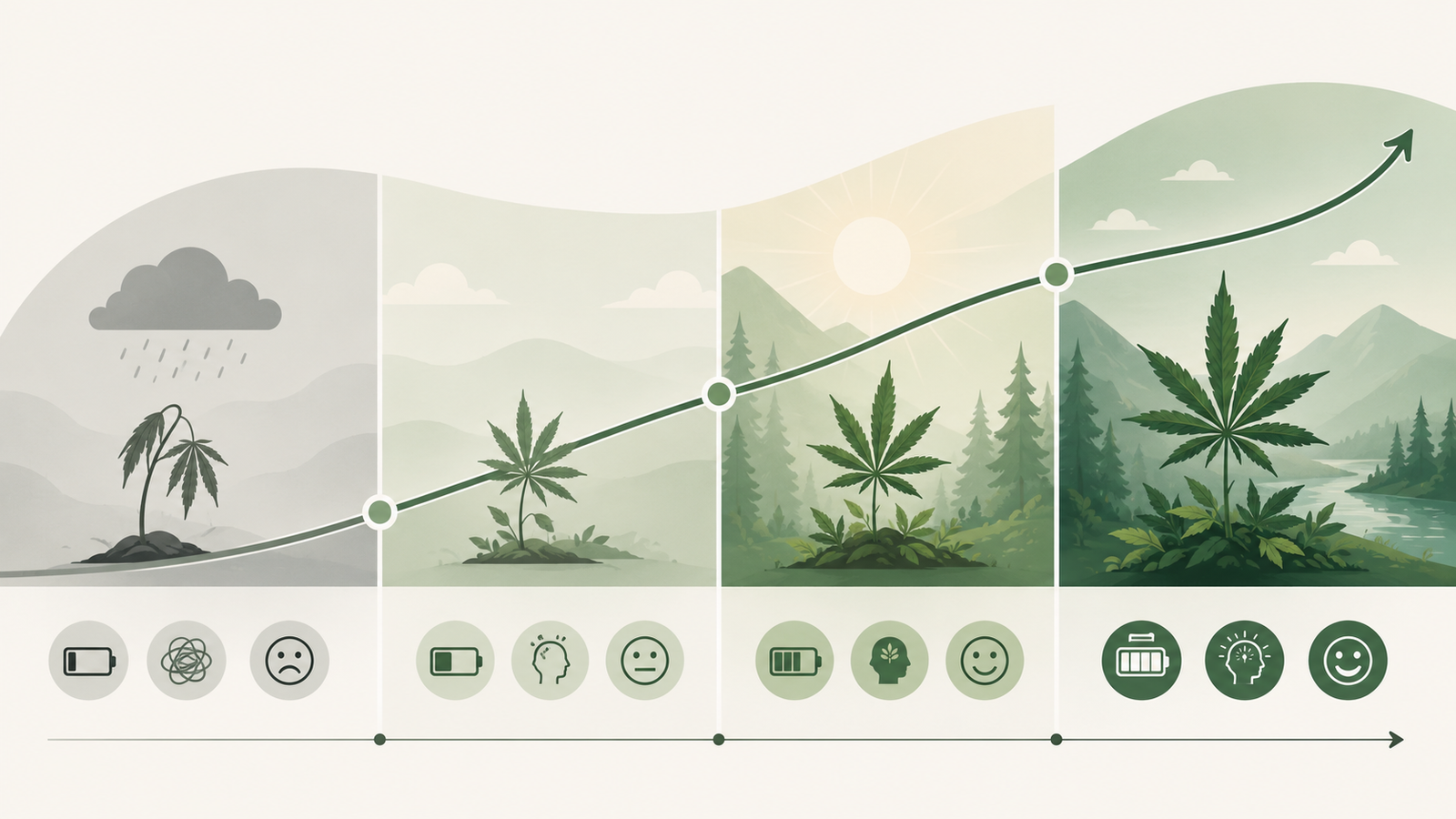
The most common tolerance break side effects are irritability and mood swings, trouble sleeping with unusually vivid dreams, mild anxiety, a dip in appetite, headaches, and daytime fatigue. They’re a normal adjustment as your body recalibrates after regular cannabis use, they usually peak in the first few days, and most people feel steadily better within one to two weeks. None of it means something is wrong—it means the reset is working.
Part of our complete cannabis tolerance break guide.
If you’re planning a T-break or you’re a few days in and wondering whether what you’re feeling is normal, this is the honest rundown: what shows up, why it happens, roughly when it eases, and what actually helps. No fear-mongering—just what to expect.
Why do tolerance breaks cause side effects at all?
When you use cannabis regularly, THC repeatedly binds to CB1 receptors in your brain. Your body adapts by dialing those receptors down—fewer of them, and less responsive—which is exactly why the same dose starts hitting softer. That adaptation is what a tolerance break undoes.
Take THC out of the picture and your endocannabinoid system has to find its footing without it. The good news, and it’s well established: CB1 receptor downregulation is reversible. Brain-imaging research by Hirvonen and colleagues (2012, Molecular Psychiatry) found that receptor availability returned toward normal after roughly four weeks of abstinence in daily users. The side effects are the felt experience of that recalibration—temporary noise while the system re-tunes.
It’s also worth naming plainly: this is a normal physiological adjustment, not a moral failing or a sign of damage. For a fuller picture of the underlying biology, see our guide to what cannabis tolerance is and how it builds.
The common tolerance break side effects
Not everyone gets all of these, and intensity varies a lot with how often and how much you used. For frequent, high-dose users the effects tend to be more noticeable; for occasional users they may be barely there. The usual suspects:
- Irritability and mood swings. A shorter fuse and general restlessness are the most frequently reported effects.
- Anxiety or unease. Often mild, sometimes just a keyed-up, can’t-settle feeling, especially in the evenings.
- Sleep problems and vivid dreams. Trouble falling asleep, lighter sleep, and unusually intense or strange dreams (more on why below).
- Reduced appetite. The flip side of the munchies—food may feel less interesting for a few days.
- Headaches. Common early on and usually short-lived.
- Fatigue or low mood. A flat, tired stretch as your system adjusts to running without THC.
- Sweating or vivid physical restlessness. Some people report night sweats or feeling generally wired.
The U.S. National Institute on Drug Abuse notes that regular cannabis users can experience these kinds of adjustment symptoms when they stop—mood changes, sleep difficulty, decreased appetite and restlessness among them. You can read more via NIDA’s cannabis research overview. The point isn’t to alarm you; it’s that what you’re feeling is documented, expected, and self-limiting.
How long do tolerance break side effects last?
For most people, the sharpest discomfort lands in the first one to three days, plateaus through roughly the first week, and fades over the following week. By the two-week mark, most side effects have largely resolved even if sleep takes a little longer to fully normalize. Here’s a typical shape:
- Days 1–3: The peak. Irritability, headaches, appetite dip and the first restless nights show up strongest here.
- Days 4–7: Mood and appetite usually start to level out. Sleep is often still the stubborn one, with vivid dreams common.
- Week 2: Most effects ease considerably. Many people notice cannabis feels noticeably stronger when they eventually return.
Timelines are individual—heavier, longer-term use generally means a longer tail. If you want to match your break length to your goal, our guide to how long a tolerance break should be and the cannabis tolerance break chart lay out realistic day-by-day expectations.
Why can’t I sleep during a tolerance break? (REM rebound)
Sleep is the effect people ask about most, and there’s a clean explanation for the strange part: the vivid dreams. THC tends to suppress REM sleep—the stage where most dreaming happens. When you use nightly for a long time, your brain runs short on REM. Remove the THC and it makes up the deficit in a burst, which sleep researchers call REM rebound.
The result is more dreaming, more intense dreaming, and dreams you actually remember—sometimes to a startling degree. It can feel disruptive, but it’s a sign your natural sleep architecture is coming back online, and it typically settles within one to two weeks. Falling asleep may also take longer at first for the same reason your other systems are readjusting.
How to cope with tolerance break side effects
You can’t skip the adjustment entirely, but you can take a lot of the edge off. Practical, low-effort moves that genuinely help:
- Tighten up sleep hygiene. Consistent bed and wake times, a dark cool room, and no screens in the last hour give your rebounding sleep the best shot. Try to accept the vivid dreams rather than fight them.
- Move your body. Even a daily walk or light exercise helps mood, appetite and sleep, and burns off restless energy.
- Stay hydrated and eat regularly. Drink water, and eat on a schedule even when appetite is low so energy stays steady.
- Time the break well. Start it during a lower-stress stretch—not the week of a big deadline or a major life event—so the mood dip has less to work with.
- Lean on ordinary comforts. Caffeine in the morning only, a wind-down routine, tea, and a bit of patience. Most people report the second week is much easier than the first.
- Remember the payoff. Lower tolerance means the same dose hits harder afterward—often meaning less product for the same effect.
If a full break feels like more disruption than you want to take on, a shorter or partial reset is a legitimate option too. Our piece on lowering weed tolerance without fully quitting and these surprising truths about tolerance breaks cover approaches that spread the adjustment out.
Does a tolerance break cause withdrawal?
For frequent, heavy users, some of these side effects overlap with what researchers describe as mild cannabis withdrawal—irritability, sleep trouble, appetite changes and restlessness. For occasional users, a break usually passes with little more than a couple of off nights. Either way, the symptoms are typically mild, physically safe, and temporary.
Framing matters here: this isn’t dangerous, and it isn’t a sign you’ve done something to yourself. It’s your endocannabinoid system returning to baseline—the same reversible process the research describes.
When to talk to a healthcare provider
Ordinary tolerance break side effects don’t need medical attention—they ease on their own. But check in with a healthcare provider if symptoms are severe, don’t improve after a couple of weeks, or interfere with your ability to function day to day. That’s especially worth doing if you experience serious anxiety, depression or persistent insomnia, if you’re managing a health condition, are pregnant or nursing, or take medication that could interact.
There’s no downside to asking. A quick conversation can rule out anything unrelated and give you tailored guidance. Cannabis laws vary by location—follow yours, and this content is for 21+ adults and is educational, not medical advice.
Frequently asked questions
What are the side effects of a tolerance break?
The most common are irritability and mood swings, mild anxiety, trouble sleeping with vivid dreams, reduced appetite, headaches and daytime fatigue. Not everyone gets all of them, and they’re usually more noticeable for frequent, high-dose users than for occasional ones.
How long do tolerance break side effects last?
They typically peak in the first one to three days and fade over one to two weeks. Sleep and vivid dreams are often the last to settle. Heavier, longer-term use generally means a slightly longer adjustment period.
Why can’t I sleep during a tolerance break?
THC suppresses REM sleep, so long-term use builds a REM deficit. When you stop, your brain makes it up in a burst—REM rebound—causing more, and more vivid, dreams plus lighter sleep. It’s temporary and usually settles within a week or two as your natural sleep pattern returns.
Does a tolerance break cause withdrawal?
For heavy users, some side effects overlap with mild cannabis withdrawal—irritability, poor sleep and appetite changes. For occasional users it’s usually barely noticeable. In both cases the symptoms are typically mild, physically safe and short-lived as CB1 receptors return to normal.
The bottom line
Tolerance break side effects are a normal, temporary part of resetting your system—uncomfortable for a few days, then steadily better, with a stronger high waiting on the other side. Plan the timing, protect your sleep, keep moving, and give it two weeks.
Want to understand the reset itself—and the options for getting the effect back with less disruption? See how the olivetol-based reset works to weigh your next step.