
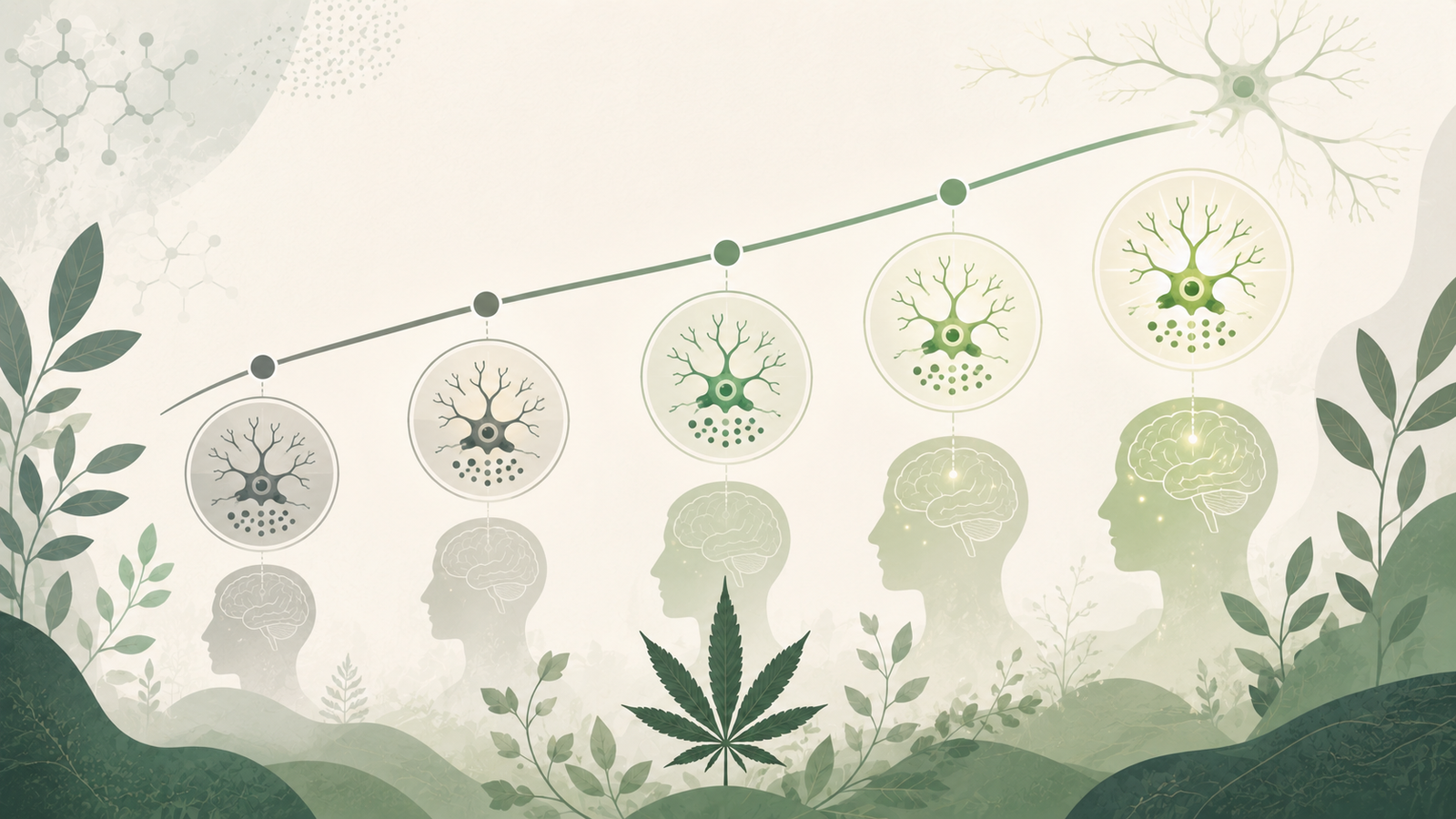
Your weed tolerance is so high because your body has adapted to regular THC exposure. The more often you use, the more potent your products, and the bigger your doses get, the more your CB1 receptors pull back and stop responding as strongly. It usually comes down to some mix of high frequency, high-potency dabs or carts, slowly creeping doses, and your own genetics and metabolism. The reassuring part: a high tolerance is a normal, reversible adaptation—not something you broke—and you can bring it back down.
The short answer: your receptors adapted
THC gets you high by binding to CB1 receptors—the docking points scattered across your brain and nervous system. When you use cannabis regularly, your brain protects itself from constant stimulation by pulling those receptors off the cell surface, a process called down-regulation.
Fewer available receptors means the same dose of THC has fewer places to act. So it hits softer, and you reach for more to close the gap. That is the entire mechanism behind a high tolerance: not weaker weed, but fewer open receptors for it to work on. If you want the full picture, our pillar guide on what cannabis tolerance is—its causes, symptoms, and timeline walks through the whole process.
Why is my weed tolerance so high? The real causes
A high tolerance is almost never one thing. It’s usually several of these stacking on top of each other.
1. You use often
Frequency is the biggest driver. Occasional use lets your receptors recover between sessions; daily or multiple-times-a-day use never gives them the chance. The more consistently THC is in your system, the harder and faster your brain down-regulates. Our guide on how long it takes to build a weed tolerance shows just how quickly this can climb with regular use.
2. Your products are stronger than they used to be
Modern cannabis is potent. Flower routinely tests in the 20–30% THC range, and concentrates—dabs, wax, and vape carts—can run 70–90%+. Every high-potency session floods your receptors with far more THC than mid-strength flower would, which trains a higher tolerance faster. If you’ve moved from flower to carts or dabs, that jump alone can explain a big shift.
3. Dose creep
Tolerance and dose feed each other in a loop. As the effect fades, you naturally take a little more to chase it. That higher dose then pushes your tolerance up again, so next time you need even more. Most people don’t notice the creep—they just wake up one day needing three times what they started with. The first sign is often your spend, not the high itself.
4. Genetics and metabolism
Some people simply build tolerance faster. Differences in CB1 receptor genes and in the liver enzymes that process THC mean two people on identical habits can land in very different places. It’s part of why a friend seems to stay sensitive while you climb. This is largely outside your control—see whether weed tolerance is genetic for what the research suggests—but it’s a piece of the puzzle, not the whole answer.
5. You’ve had more exposure than you think
People routinely underestimate their real intake. Edibles hang around for hours, THC stores in body fat and releases slowly, and “just a couple hits” through the day quietly adds up. If it feels like your tolerance is higher than your habit should justify, your cumulative exposure is probably larger than your mental tally.
Why did my tolerance get high suddenly?
A tolerance that seems to spike overnight usually isn’t sudden at all—it’s a threshold you finally crossed. Down-regulation builds quietly in the background, and the change becomes obvious only once your receptors drop below the point where your usual dose still works.
That said, a few things can make it feel abrupt. Switching to concentrates or stronger carts, increasing how often you use, a stretch of heavy days in a row, or a more potent batch than usual can all tip you over the edge in a short window. What feels like a sudden jump is often a real change in frequency or potency that your receptors caught up to fast.
Is a high tolerance permanent?
No—and this is the most important part. A high tolerance is a reversible adaptation, not permanent damage. The same down-regulation that raised your tolerance runs in reverse when you give your receptors a break.
The clearest evidence comes from a brain-imaging study by Hirvonen and colleagues (2012), published in Molecular Psychiatry. They found that CB1 receptors are down-regulated in chronic cannabis users but return toward normal levels after roughly four weeks of abstinence. In other words, the receptors come back—your body rebuilds what heavy use pulled down. You didn’t break anything, and it’s usually reversible.
How do I fix a high tolerance?
The goal is the same either way: give your CB1 receptors room to resensitize so a normal dose works again. You have a few honest options.
- Take a tolerance break (T-break). The classic reset. Fully abstaining gives receptors the clearest path back—Hirvonen’s four-week figure is a useful benchmark, though many users notice meaningful improvement sooner.
- Cut back without fully quitting. Lowering frequency, dropping potency (concentrates back to flower), and holding a smaller dose can bring tolerance down over time.
- Reset intentionally rather than drifting. A planned approach beats guessing. Our guide on how to reset cannabis tolerance lays out the timeline and the methods side by side.
If a multi-week break isn’t realistic, one option in this space is Undoo Reset, an olivetol-based softgel marketed as an alternative to a traditional T-break—designed to change receptor occupancy over a few nights rather than asking you to abstain. It’s worth understanding what it is and isn’t before you spend money on it.
Undoo Reset is a dietary supplement. It is not intended to diagnose, treat, cure, or prevent any disease, and it is not a way to pass a drug test. This page contains affiliate links. 21+ only; follow your local laws. If you’re pregnant, nursing, on medication, or managing a health condition, talk to a healthcare provider first.
Frequently asked questions
Why is my weed tolerance so high?
Because your CB1 receptors adapted to regular THC by down-regulating—pulling back so the same dose has fewer places to act. It’s usually driven by a mix of high frequency, high-potency products like dabs and carts, slowly creeping doses, and your own genetics and metabolism. More exposure than you realize often plays a part too.
Why did my tolerance get high suddenly?
It rarely happens overnight—down-regulation builds quietly until you cross the point where your usual dose stops working, which feels sudden. Switching to concentrates or stronger carts, using more often, or a run of heavy days can tip you over fast, making a gradual change look like a spike.
Is a high tolerance permanent?
No. It’s a reversible adaptation. Hirvonen and colleagues (2012) found CB1 receptors down-regulated in chronic users returned toward normal after about four weeks of abstinence. Give your receptors a break and they resensitize—your tolerance comes back down.
How do I fix a high tolerance?
Give your CB1 receptors room to recover. A full tolerance break is the clearest route; cutting frequency, dropping potency, and holding a smaller dose also work over time. For a step-by-step plan, see our guide on how to reset cannabis tolerance. Olivetol-based Undoo Reset markets a shorter, no-abstinence alternative worth researching.
Bottom line: a high weed tolerance means your receptors adapted to how much and how often you use—normal, common, and reversible. If you’d like the magic back, see how the olivetol reset works and decide what fits your routine.