
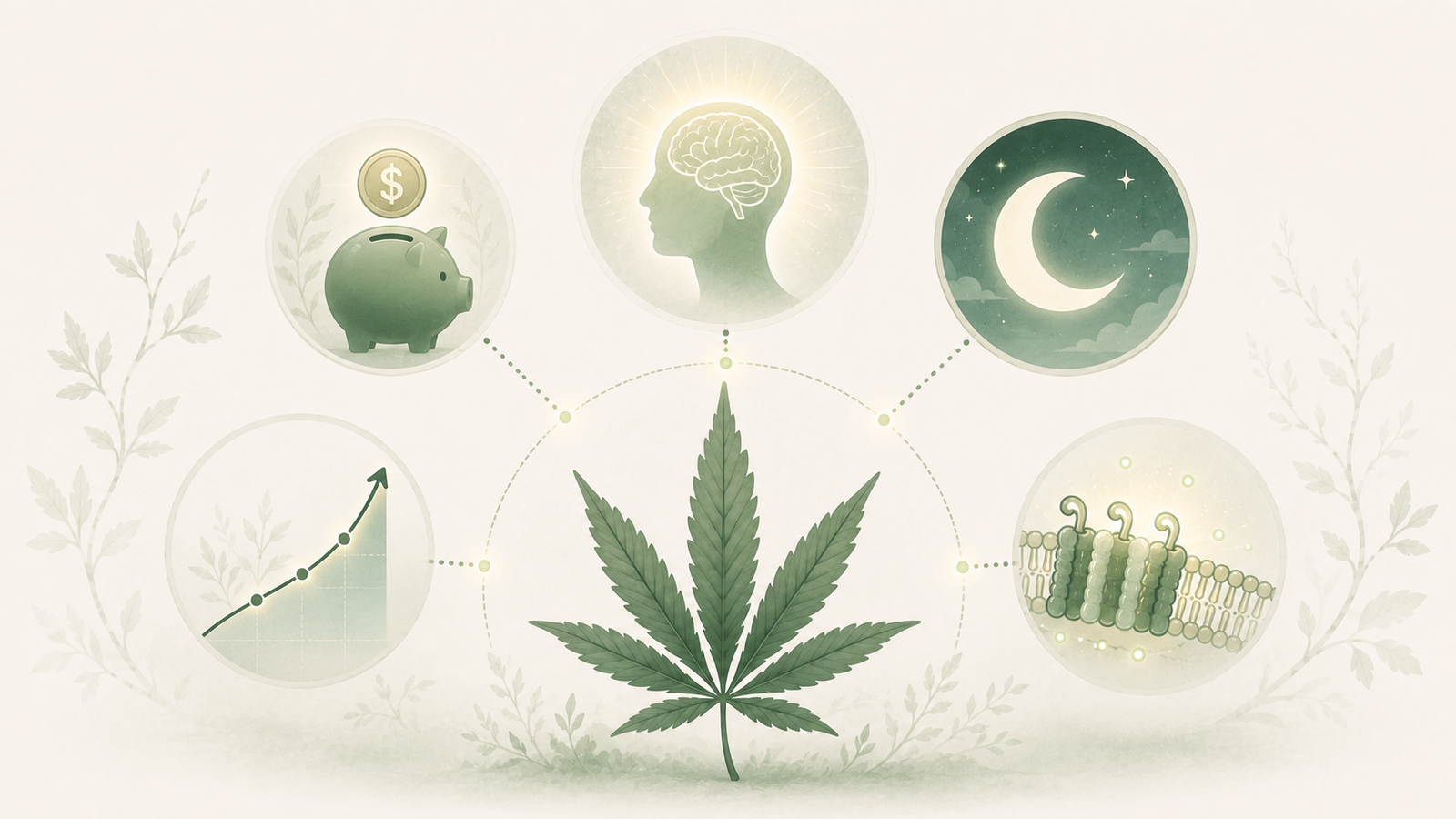
No — not if you want the break to actually work. A tolerance break resets your tolerance by removing THC so your CB1 receptors can recover, so continuing to smoke keeps the very thing you’re trying to clear in your system. You can absolutely reduce or lower your use instead, and that helps, but that’s a different tool with a different payoff. Here’s what actually happens if you keep using during a break, where the line really is, and the honest option for people who don’t want to fully abstain.
Part of our complete cannabis tolerance break guide.
Why smoking undercuts a tolerance break
A tolerance break isn’t magic — it works on a specific mechanism. When THC repeatedly binds to your CB1 receptors, your brain pulls some of those receptors out of circulation to protect itself, a process called downregulation. Fewer available receptors is why the same dose lands softer over time.
The break works by reversing that. A brain-imaging study by Hirvonen et al. (2012) in Molecular Psychiatry found that CB1 receptor density in chronic cannabis users returned toward normal after roughly four weeks of abstinence. The key word is abstinence — the receptors resensitize because the THC stops arriving. Keep smoking, and you keep occupying those receptors, which is exactly the signal that told your brain to downregulate in the first place. For the full picture of how this builds, see our guide to what cannabis tolerance is, its causes and timeline.
What happens if you keep smoking during a break?
Practically, you slow or stall the reset. Receptor recovery is time-dependent, so every session you sneak in restarts part of the clock and keeps your receptors occupied. You might still get some benefit from using less — but you won’t get the clean resensitization that makes a break worth the discomfort.
There’s also a psychological cost. A break you keep interrupting rarely delivers the payoff you were hoping for, which makes the whole thing feel pointless — and makes you less likely to try again. If you’re going to commit to a break, committing fully is what earns the result.
Reducing isn’t the same as a full break
Here’s the nuance that trips people up: cutting back and taking a break are two different strategies, and both are valid — they just do different things. A full break aims for a deeper reset by clearing THC entirely. Reducing aims to slow and gently reverse tolerance creep while you keep using.
If a two-week stretch of nothing sounds miserable, lowering your intake is a legitimate middle path. It won’t reset you as completely, but less THC hitting your receptors means less downregulation over time, so your baseline sensitivity tends to drift back. The methods that work best:
- Cut your effective dose. Take one hit and wait, or move to a measured low-dose edible, instead of topping up out of habit.
- Drop the potency. Step down from concentrates to flower, or from high-THC strains to lower-THC ones, so less THC hits your receptors per session.
- Space out your sessions. Widening the gap between uses gives receptors time to recycle back to the surface.
We cover this route in full in how to lower weed tolerance without quitting. Just be honest with yourself about which you’re doing — a “break” where you still smoke daily is really just reducing, and it’s fair to call it that.
What about CBD or lower-potency use?
CBD is a common question because it feels like a loophole — and it’s a partial one. CBD doesn’t bind CB1 the way THC does, so a CBD-only product won’t drive the same downregulation and generally won’t sabotage a break the way THC will. Some users lean on CBD or hemp flower to keep a ritual going while the THC clears.
The honest caveat: many “low-THC” or hemp products still contain some THC, and if you’re chasing an effect, you may find yourself using more to feel it. If your goal is a true reset, treat CBD as a habit substitute, not a green light to keep dosing THC.
The “sneaking a little” trap
The most common way breaks fail isn’t quitting outright — it’s the small, quiet exceptions. One hit on a stressful night. A shared joint you didn’t plan on. “Just a little” feels harmless, but each time you reintroduce THC, you nudge those receptors back toward occupancy and blunt the recovery you’ve banked.
This isn’t about willpower or shame — cravings during a break are normal, and slipping doesn’t make you a failure. But it helps to be clear-eyed: a break is an all-or-nothing tool, and “sneaking a little” quietly converts it into the reducing strategy above. If you know you’ll want the occasional session, plan for reducing from the start rather than pretending you’re abstaining. Deciding how long a tolerance break should be up front also makes it easier to hold the line.
A reset without fully stopping: the olivetol option
If the real problem is that you don’t want to abstain at all, there’s a different route worth knowing about — olivetol, the active ingredient in Undoo Reset. Instead of asking you to clear THC by waiting, the olivetol approach is designed to work on receptor occupancy directly.
According to its composition patent (US 10,265,277 B2), olivetol is proposed to interact with CB1 receptors in a way marketed to help restore sensitivity — the idea being to change what’s happening at the receptor rather than requiring weeks off. Undoo’s training guide suggests 2 softgels with 12–16 oz of water before bed for 5 nights, and no more than 6 in 24 hours. Being straight about the evidence: the patent’s supporting reports come from informal volunteer feedback, not blinded clinical trials, so this is proposed and anecdotal rather than proven. Our 5-day tolerance reset walkthrough covers the routine in detail.
The honest trade-off is time versus certainty. A traditional break has decades of receptor-recovery science behind it — the Hirvonen findings above — but costs you weeks and asks you not to smoke. The olivetol approach is designed to be faster and doesn’t require full abstinence, but it rests on less rigorous evidence.
Undoo Reset is a dietary supplement. It is not intended to diagnose, treat, cure, or prevent any disease, and it is not a way to pass a drug test. This page contains affiliate links. 21+ only; follow your local laws, and check with a healthcare provider if you’re pregnant, nursing, on medication, or managing a health condition.
Frequently asked questions
Can you smoke on a tolerance break?
Not if you want it to work as a true reset. A tolerance break resets tolerance by removing THC so your CB1 receptors resensitize, which Hirvonen et al. (2012) linked to abstinence. Smoking keeps THC occupying those receptors, so it undercuts the mechanism. If you plan to keep smoking, you’re really reducing your use, not taking a break — a valid strategy, just a different one.
Does a tolerance break work if you still smoke a little?
Not as well. Every time you reintroduce THC, you nudge your receptors back toward occupancy and slow the recovery, since resensitization is time- and abstinence-dependent. “Sneaking a little” quietly turns a break into a reducing routine. You’ll still get some benefit from using less, but not the fuller reset that full abstinence delivers.
Can you use CBD on a tolerance break?
Generally yes. CBD doesn’t bind CB1 the way THC does, so CBD-only products usually won’t drive the downregulation you’re trying to reverse, and some people use them to keep a ritual going. The catch: many “low-THC” or hemp products still contain some THC, so check labels and treat CBD as a habit substitute rather than a reason to keep dosing THC.
Is there a way to reset tolerance without quitting?
You can slow and gradually reverse tolerance by cutting your dose, dropping potency, and spacing sessions — no full stop required. For a faster route, the olivetol-based Undoo Reset is marketed as a 5-night approach designed to work on receptor occupancy without abstinence. It’s a dietary supplement and the supporting reports are anecdotal, not clinical, so results aren’t guaranteed and some users report more than others.
The bottom line
A tolerance break and smoking don’t mix — the break works precisely because the THC stops. If quitting for weeks isn’t realistic, be honest and switch to reducing, or look at a reset that doesn’t require abstaining. Either way you didn’t break anything; your endocannabinoid system adapted, and it can adapt back. If a no-quit path appeals, see how the olivetol reset works and decide whether it fits you.