
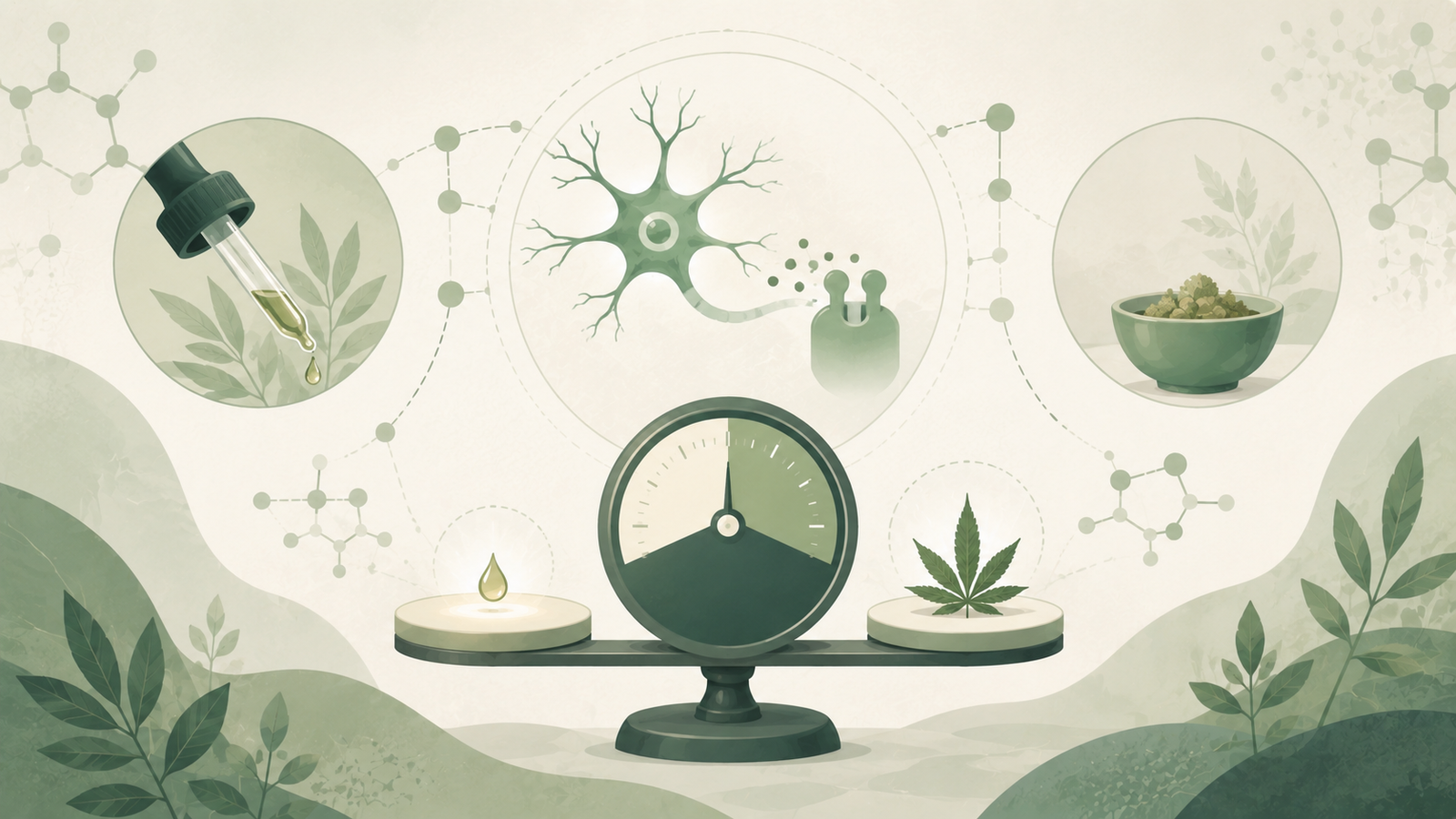
Microdosing cannabis is one of the most effective ways to keep your tolerance from climbing. By using your minimum effective dose of THC instead of always taking more, you put less pressure on your CB1 receptors, which slows the downregulation that drives tolerance in the first place. The honest catch: microdosing is far better at preventing tolerance buildup than at resetting a tolerance that’s already high.
Below, we’ll cover what a microdose of THC actually is, why smaller doses protect your sensitivity, and a practical way to microdose weed without your dose creeping back up.
Does microdosing lower cannabis tolerance?
Microdosing lowers the pressure that raises tolerance, and over time it can let a mildly elevated tolerance drift back down — but it isn’t a fast reset. To see why, it helps to know what tolerance actually is.
When THC repeatedly binds to your CB1 receptors, your brain pulls some of those receptors out of circulation, a process called downregulation. Fewer available receptors means the same dose lands softer, so you reach for more. The more THC you flood in, and the more often, the harder that adaptation pushes. A microdose does the opposite: it gives your receptors a much lighter load to respond to.
The reassuring part is that this adaptation is reversible. A brain-imaging study by Hirvonen et al. (2012) in Molecular Psychiatry found that CB1 receptor density in chronic cannabis users returned toward normal after about four weeks of abstinence. Microdosing works with the same biology from the other direction — instead of removing THC entirely, it keeps the ongoing dose small enough that downregulation stays limited. If you want the full picture of how tolerance forms, see our guide to what cannabis tolerance is, its causes, symptoms, and timeline.
What is a microdose of THC?
A microdose of THC is the smallest amount that gives you a noticeable, functional effect without a strong high — for most people, that’s roughly 1 to 5 mg of THC, though the exact number varies with your body, your tolerance, and how you consume.
The goal isn’t to feel blitzed. It’s to feel a light, useful shift — a bit of relaxation or relief — using as little THC as possible. Someone brand new to cannabis might microdose at 1–2 mg, while a seasoned daily user might need more to feel anything at all, which is itself a sign their tolerance has climbed. If you’re not sure where you land, our breakdown of what counts as a high THC tolerance can help you gauge it.
Microdosing is easiest with products you can measure. Low-dose edibles, tinctures with a dropper, or a single small inhalation give you far more control than free-pouring flower or dabbing, where the dose is hard to pin down.
How do you microdose weed?
The core idea is simple: start low, wait, track what you feel, and resist the urge to top up. Here’s a practical routine.
- Start low. Begin with a small, known dose — around 2.5 mg of THC in an edible or tincture, or a single inhalation of flower — rather than a full session’s worth.
- Wait it out. Give inhaled cannabis a full 10–15 minutes and edibles a full 1–2 hours before deciding it “isn’t working.” Most top-ups happen because people judge too early.
- Don’t top up. This is the hardest and most important rule. If the effect is light but present, that’s the point. Adding more defeats the purpose and starts nudging your tolerance back up.
- Track it. Keep a rough log of how much you took, when, and how you felt. A written record makes creeping dose escalation visible before it becomes a habit.
- Find your floor, then hold it. Once you know the smallest dose that reliably works for you, treat that as your default instead of your starting point.
Spacing matters too. Even when microdosing, giving your receptors time between doses helps them recycle back to the surface, so a microdose in the evening tends to land better than grazing all day. For more ways to keep using while easing tolerance, see our guide to how to lower weed tolerance without quitting.
Can microdosing prevent tolerance?
Microdosing can’t fully prevent tolerance — any regular THC exposure causes some adaptation — but it slows the buildup dramatically compared with high-dose, all-day use. This is where microdosing genuinely shines: as prevention and maintenance, not as a cure.
If you’re starting from a fresh or low tolerance, microdosing helps you keep it there and stretch your supply further, since less THC does the job. If you’re already deep into a high tolerance, microdosing alone will feel underwhelming at first — small doses may barely register until your sensitivity recovers. In that case, microdosing is better used after a reset to protect the gains, rather than as the reset itself.
For general, neutral background on how cannabis affects the brain and body, the National Institute on Drug Abuse (NIDA) is a solid source worth reading.
Microdosing vs. resetting an already-high tolerance
If your tolerance is already high, the honest move is to reset it first, then microdose to keep it low. Microdosing is a maintenance tool; it isn’t designed to claw back sensitivity you’ve already lost.
A traditional tolerance break — a stretch of abstinence — has the strongest evidence behind it, since receptor recovery is time-dependent. If a long break isn’t realistic, there are faster-leaning options too, including the olivetol-based supplement Undoo Reset, which is marketed as a 5-night alternative. To weigh the full menu of approaches side by side, start with our overview of how to reset cannabis tolerance, then come back to microdosing to hold your lower baseline.
Undoo Reset is a dietary supplement. It is not intended to diagnose, treat, cure, or prevent any disease, and it is not a way to pass a drug test. This page contains affiliate links. 21+ only; follow your local laws, and check with a healthcare provider if you’re pregnant, nursing, on medication, or managing a health condition.
Frequently asked questions
Does microdosing lower tolerance?
Microdosing lowers the pressure that raises tolerance, and over time it can let a mildly elevated tolerance drift back down. Because you’re taking your minimum effective dose of THC, your CB1 receptors face less downregulation than they would with heavy, frequent use. It’s more of a slow, preventive effect than a fast reset of an already-high tolerance.
How do you microdose weed?
Start with a small, measurable dose — around 2.5 mg of THC or a single inhalation — then wait the full onset time before deciding whether you need more. The key rules are don’t top up, track how each dose feels, and once you find the smallest amount that works, hold it as your default. Measurable products like low-dose edibles or tinctures make this much easier.
Can microdosing prevent tolerance?
It can’t fully prevent it — any regular THC use causes some adaptation — but microdosing slows tolerance buildup significantly compared with high-dose use. It works best as prevention and maintenance: keeping a low tolerance low, or protecting the gains after you’ve reset. Starting from an already-high tolerance, microdosing alone will feel weak until your sensitivity recovers.
What is a microdose of THC?
A microdose of THC is the smallest amount that produces a light, functional effect without a strong high — usually around 1 to 5 mg, depending on your body and tolerance. The aim is a subtle, useful shift using as little THC as possible, not intoxication. New users may feel it at 1–2 mg, while higher-tolerance users often need more, which is itself a signal their tolerance has climbed.
The bottom line
Microdosing is one of the smartest habits for keeping cannabis tolerance low: use your minimum effective dose, wait, track, and resist topping up. Just be realistic about what it does — it prevents and maintains far better than it resets. If your tolerance has already climbed, see how the olivetol reset works, get your sensitivity back, and then let microdosing keep it there.