
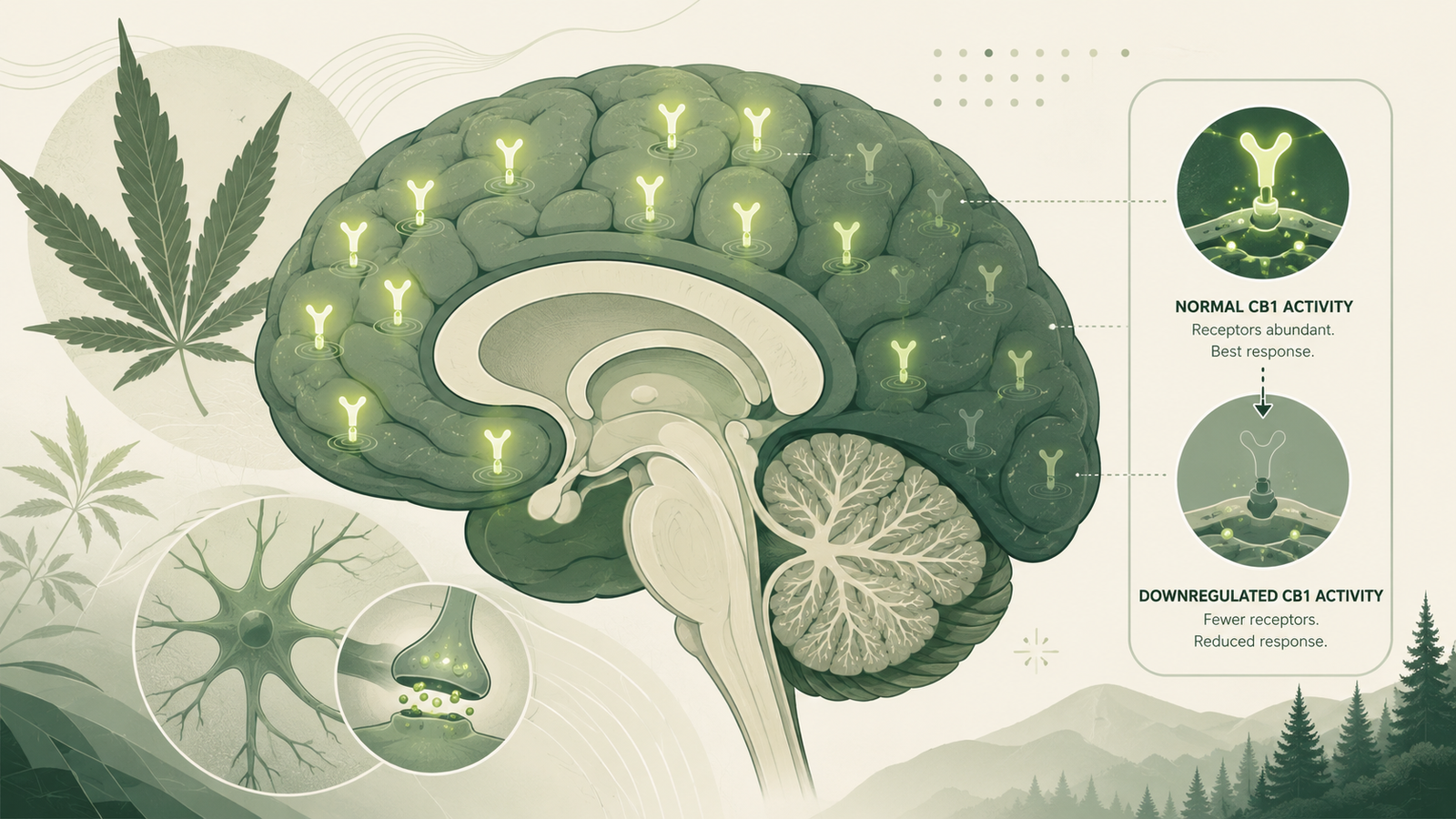
To reset your endocannabinoid system, you mainly need to give your CB1 receptors a break from the THC that has been keeping them busy. When you reduce or pause cannabis, those receptors gradually return to their normal number and sensitivity – a process researchers have measured returning to baseline after roughly four weeks of abstinence. Sleep, exercise, omega-3 fatty acids, and lower stress support that recovery, and an olivetol-based approach is an emerging option some people use to influence receptor occupancy without a long break.
Part of our guide on how to reset cannabis tolerance.
Let’s unpack what’s actually happening, what “reset” really means, and which levers have evidence behind them versus which are supportive but unproven.
What is the endocannabinoid system?
The endocannabinoid system (ECS) is a signaling network your body uses to keep things in balance – appetite, mood, sleep, pain, and stress response all run through it. It makes its own cannabinoids (like anandamide), and it has receptors those molecules dock into, the main one being the CB1 receptor in your brain and nervous system.
THC works because it fits those same CB1 receptors. That’s the whole reason cannabis does anything at all. The National Institute on Drug Abuse (NIDA) describes how THC binds to cannabinoid receptors and disrupts the ECS’s normal signaling – which feels great in the moment but nudges the system to adapt over time.
What does “resetting” your endocannabinoid system actually mean?
When you use THC regularly, your CB1 receptors respond to the constant stimulation by pulling back. Your brain reduces the number of available receptors on the surface of your cells – a process called downregulation. Fewer receptors means the same dose has fewer places to bind, so you feel less. That’s tolerance in a nutshell, and we cover the full picture in what cannabis tolerance is, its causes and timeline.
So “resetting” isn’t a detox or a flush. It’s letting those receptors come back – both in number (upregulation) and in sensitivity (resensitization). The encouraging part: this adaptation is reversible. In a brain-imaging study, Hirvonen et al., 2012, in Molecular Psychiatry, found that CB1 receptor density in chronic cannabis users was reduced but returned to roughly normal levels after about four weeks of abstinence.
In other words: you didn’t break anything. Your ECS adapted, and it can adapt back. For a timeline-focused breakdown, see how long it takes to reset cannabis tolerance.
How to reset your endocannabinoid system: the evidence-based levers
The receptors do the recovering on their own. Your job is to remove the pressure that’s keeping them downregulated and support the conditions that help them bounce back. Here are the levers, strongest evidence first.
- Reduce or pause THC. This is the one that actually drives the reset. A full tolerance break gives CB1 receptors the clearest runway to recover, and the Hirvonen data suggests meaningful normalization within about four weeks. If quitting isn’t for you, cutting back or lowering your dose still eases the pressure – more on that in how to lower weed tolerance without quitting.
- Prioritize sleep. The ECS is closely tied to your sleep-wake cycle, and heavy THC use can disrupt sleep architecture. Giving your body consistent, quality sleep supports the normal signaling the ECS depends on.
- Exercise. Physical activity can raise your body’s own endocannabinoids (anandamide is part of the so-called “runner’s high”). Regular movement supports healthy ECS tone and is a low-risk habit worth keeping during a reset.
- Get enough omega-3 fatty acids. Your endocannabinoids are built from omega-3 and omega-6 fats, so dietary omega-3s (fatty fish, flax, walnuts) provide raw material the ECS uses. The research here is early, but the nutritional logic is sound and the downside is minimal.
- Lower chronic stress. Stress and the ECS are deeply linked, and prolonged stress can throw endocannabinoid signaling off balance. Managing it – through sleep, movement, or whatever works for you – removes another headwind to recovery.
Be honest with yourself about the evidence tiers here. Cutting THC is the proven driver. Sleep, exercise, omega-3s, and stress reduction are supportive – biologically plausible and good for you regardless, but not a shortcut that replaces reducing THC. Anyone selling a supplement that “resets your ECS overnight” is overpromising.
Where olivetol fits in
Olivetol is a compound found in cannabis that’s chemically related to THC’s building blocks. It’s the active ingredient in Undoo Reset, an olivetol softgel marketed as an alternative to a long tolerance break. You can read our full explainer on what olivetol is.
Here’s the proposed mechanism, attributed to the olivetol composition patent (US 10,265,277 B2): rather than waiting weeks for your CB1 receptors to upregulate, olivetol is described as occupying or interacting with cannabinoid receptor sites – a bit like taking up parking spots – which the patent suggests could influence how you respond to THC. It’s an emerging, receptor-occupancy idea, not a shortcut to regrowing receptors.
Worth being clear-eyed: the patent’s supporting evidence includes informal volunteer reports, not blinded clinical trials. So the olivetol approach is best filed under “proposed and anecdotal,” not “proven.” It’s a tool some people try when a multi-week break isn’t realistic – not a replacement for the fundamentals above.
Undoo Reset is a dietary supplement. It is not intended to diagnose, treat, cure, or prevent any disease, and it is not a way to pass a drug test. This page contains affiliate links. 21+ only; follow your local laws, and check with a healthcare provider before starting any supplement – especially if you’re pregnant, nursing, on medication, or managing a health condition.
Frequently asked questions
How do you reset your endocannabinoid system?
You reset it mainly by reducing or pausing THC so your CB1 receptors can return to their normal number and sensitivity. Supporting habits – consistent sleep, regular exercise, omega-3 fatty acids, and lower chronic stress – help create the conditions for that recovery. There’s no detox or flush involved; the system re-balances on its own once you ease the pressure.
How long does it take to reset CB1 receptors?
Research suggests roughly four weeks. Hirvonen et al. (2012) found that CB1 receptor density in chronic users was down but returned to about normal after around four weeks of abstinence. Everyone’s different – how much and how long you used affects the pace – but four weeks is a reasonable benchmark for a meaningful reset.
Can you upregulate cannabinoid receptors?
Yes. Upregulation – your cells increasing the number of available CB1 receptors – is exactly what happens when you take pressure off the system by reducing THC. The imaging data shows receptor levels recovering during abstinence. Lifestyle factors like sleep, exercise, and omega-3 intake are thought to support healthy ECS function, though reducing THC is the main driver.
Do CB1 receptors grow back?
They don’t disappear in the first place – regular THC use causes your cells to pull receptors back from the surface (downregulation), not destroy them. So “growing back” is really the receptors becoming available and sensitive again, which the research shows happens with reduced use over a few weeks.
The bottom line
Resetting your endocannabinoid system isn’t a cleanse – it’s giving your CB1 receptors room to recover, which the science says they will. Reducing THC does the heavy lifting; sleep, exercise, omega-3s, and stress management support the process; and olivetol is an emerging option for people who’d rather not take a long break. If a multi-week T-break isn’t in the cards, see how the olivetol-based Undoo Reset approach is designed to work and decide what fits you.