
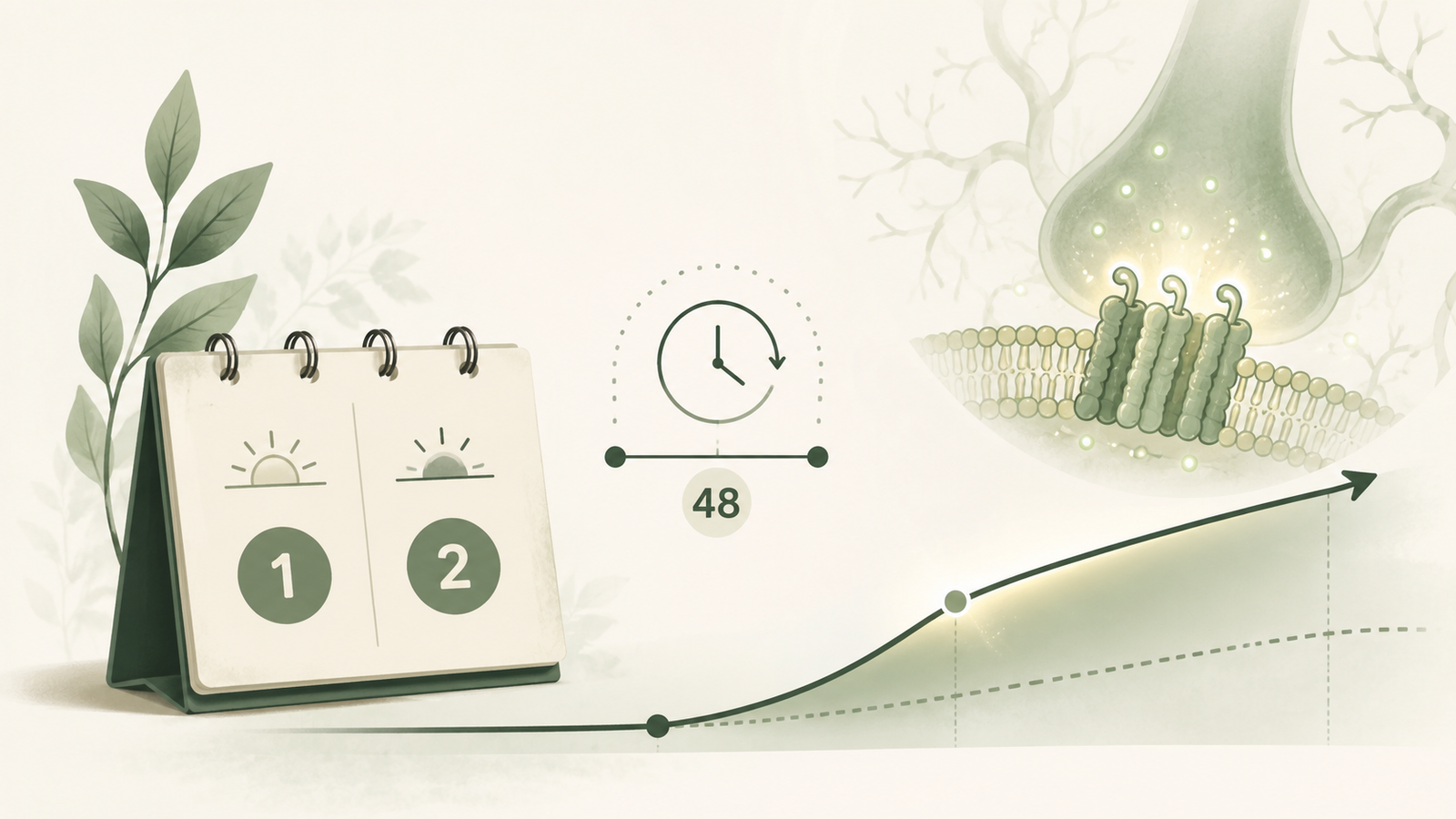
Yes, a 2-day (48-hour) tolerance break does something—especially if you’re a light-to-moderate user. Your CB1 receptors start becoming more responsive to THC almost as soon as you stop, so many people notice their next session feels a little stronger. For heavy daily users, 48 hours is a real start but only a start: it takes the edge off, while three days, a week, or longer keep delivering more.
Part of our complete cannabis tolerance break guide.
What actually happens in the first 48–72 hours
When you use cannabis regularly, your brain adapts by pulling CB1 receptors—the docking points THC binds to—off the cell surface. Fewer available receptors means the same dose has fewer places to act, so it hits softer. That’s tolerance, and it’s a normal physiological adjustment, not a sign you broke anything.
Stop using, and that process starts to reverse. A brain-imaging study by Hirvonen and colleagues (2012), published in Molecular Psychiatry, found that CB1 receptor levels in chronic users are down-regulated but return toward normal after roughly four weeks of abstinence. Crucially, that recovery is gradual—it begins during the break, not on day 28. The first couple of days are the opening stretch of a curve that keeps climbing.
So in the 48–72 hour window, receptor resensitization is underway but nowhere near finished. What you feel depends on how deep your tolerance was to begin with.
Who feels a 48-hour break the most?
Lighter and occasional users tend to notice the difference fastest. If your tolerance isn’t buried deep, a short reset can be enough to make the next session feel noticeably stronger—sometimes surprisingly so.
- Light or weekend users: 48 hours can bring a clear bump in effect. Your receptors weren’t heavily suppressed, so they bounce back quickly.
- Moderate users: You’ll likely feel some improvement at 48–72 hours, but you’re leaving reset on the table. A few more days pays off.
- Heavy daily users: 48 hours takes the edge off and lets sleep and appetite start normalizing, but your tolerance built over months—two days won’t undo it. Think of it as the first step, not the finish line.
One honest caveat: the first day or two off can come with mild, temporary side effects like restless sleep, vivid dreams, irritability, or a dip in appetite—most noticeable for heavy users. It’s common, it’s not dangerous, and it usually eases within a few days.
2 days vs. 3 days vs. a week: what’s the real difference?
There’s no magic threshold where tolerance suddenly “resets.” It’s a sliding scale—more time off means more receptor recovery. Here’s a realistic way to think about it:
- 48 hours (2 days): Resensitization has begun. Light users feel it; heavy users get a modest reset and the first signs of normalized sleep and appetite.
- 72 hours (3 days): A meaningfully better checkpoint. The extra day gives receptors more recovery time, and many people report the jump from 2 to 3 days is where the effect becomes obvious. If you can stretch a weekend into three nights, do it.
- One week: A noticeably deeper reset for most regular users, and often the sweet spot between effort and payoff.
- Two to four weeks: Where the research points for a full reset. Hirvonen’s data suggests receptors approach baseline around four weeks off.
Is 72 hours a good tolerance break? For a short, low-commitment reset, it’s arguably the best bang for your buck—long enough to feel a real difference, short enough to actually finish. If you want to see the full timeline mapped out day by day, our cannabis tolerance break chart lays out what to expect at each stage, and our guide on how long a tolerance break should be helps you match the length to your usage.
How much does a 2 day break actually lower tolerance?
Honestly, no one can put a clean percentage on it—the science measures receptor recovery over weeks, not hours, and individual factors like body composition, frequency, and potency all matter. What we can say is that recovery is real, measurable, and already moving at 48 hours; it’s just partial.
The practical takeaway: a 2-day break is worth doing, but set expectations by your usage. If you’re a heavy daily user hoping to feel like a first-timer again, 48 hours won’t get you there—three days to a week will get you closer, and a longer break closer still. To understand why your tolerance climbed in the first place, our pillar guide on what cannabis tolerance is—its causes, symptoms, and timeline breaks it down.
What if you don’t want to take a break at all?
Not everyone wants to give up 48 hours—or a week. If a break isn’t realistic right now, there are ways to stretch your tolerance without going fully abstinent, from lowering your dose to spacing out sessions. We cover the practical options in how to lower weed tolerance without quitting.
One product in this space is Undoo Reset, an olivetol-based softgel marketed as an alternative to a traditional break—designed to change receptor occupancy over a few nights rather than asking you to abstain. It’s worth knowing what it is and isn’t before you spend money on it.
Undoo Reset is a dietary supplement. It is not intended to diagnose, treat, cure, or prevent any disease, and it is not a way to pass a drug test. This page contains affiliate links. 21+ only; follow your local laws.
Frequently asked questions
Will a 2 day tolerance break do anything?
Yes. CB1 receptors begin resensitizing as soon as you stop, so light-to-moderate users often notice their next session feels stronger after 48 hours. Heavy daily users get a smaller, partial reset—real, but only the beginning of the recovery curve.
Is 72 hours a good tolerance break?
For a short reset, 72 hours is a strong choice. It’s long enough that most people feel a clear difference—often more than the jump you get from 48 hours—yet short enough to realistically complete over a long weekend.
Will a 3 day tolerance break do anything?
Yes, and typically more than two. The extra 24 hours gives your CB1 receptors additional recovery time, and many users report the effect becomes noticeably obvious around the three-day mark. It won’t fully reset a heavy tolerance, but it’s a solid, low-effort improvement.
How much does a 2 day break lower tolerance?
There’s no exact figure—the research tracks receptor recovery over weeks, and results vary by person and usage. What’s clear is that recovery is already underway at 48 hours, so a 2-day break lowers tolerance partially. A full reset points toward roughly four weeks of abstinence.
Bottom line: a 2-day break is genuinely worth doing, and stretching it to three days or a week does more. If you’d rather explore an approach that doesn’t require going without, see how the olivetol reset works and decide what fits your routine.