
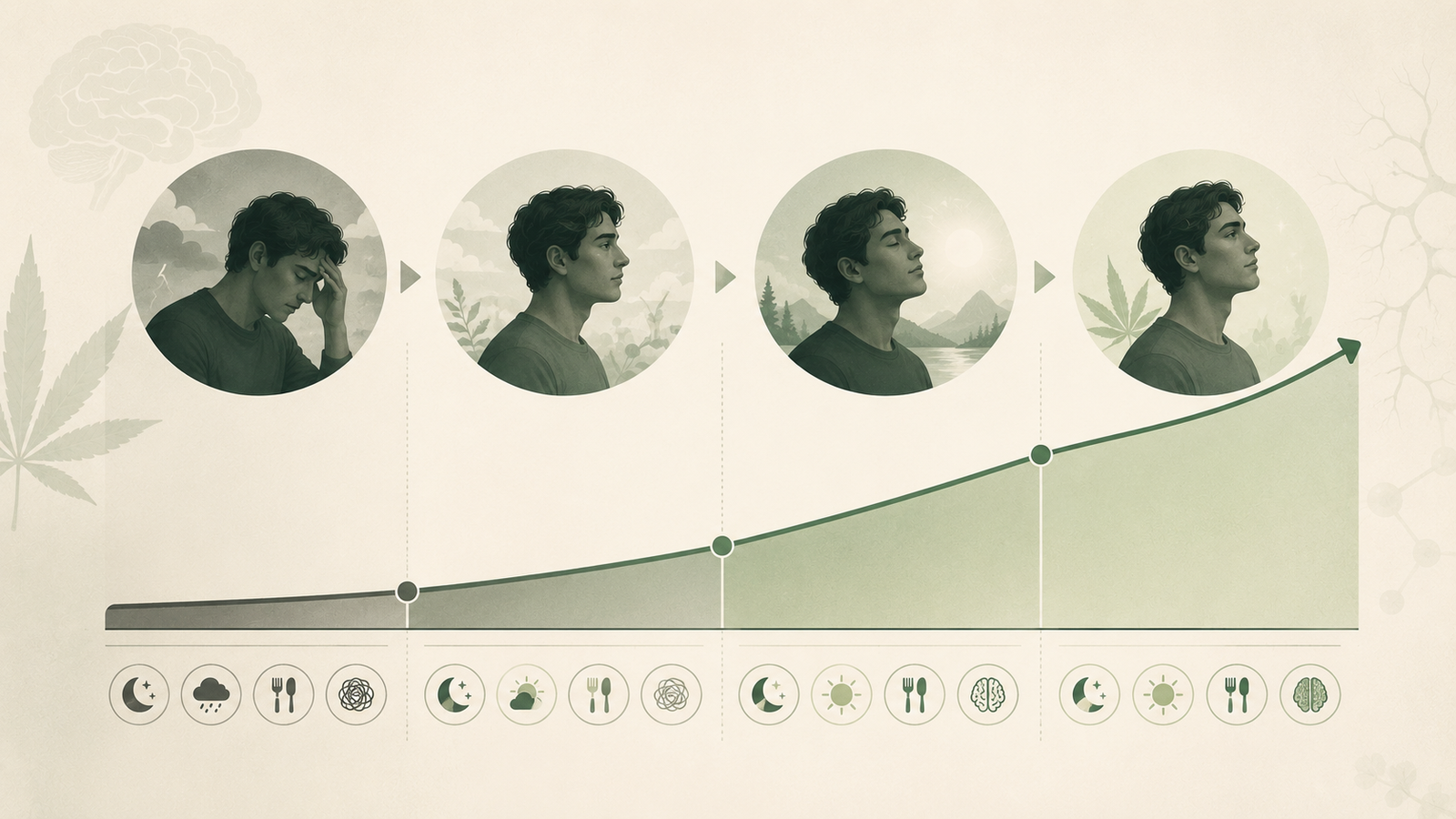
A tolerance break for daily smokers usually needs to run 2 to 4 weeks for a full reset, longer than a casual user needs. That is because heavy, everyday use causes the deepest drop in CB1 receptor availability—the receptors THC binds to—and those receptors take roughly four weeks of abstinence to return to normal. The catch: daily smokers also tend to feel the discomfort of a break earliest, in the first few days.
Part of our complete cannabis tolerance break guide.
Here is why daily use changes the math, how long your break realistically needs to be, what to expect along the way, and a few ways to make it easier—including an option for people who can’t take weeks off at all.
Why daily smokers are different
Tolerance builds because your brain adapts to a steady flood of THC. With regular use, CB1 receptors down-regulate—they become less available—so the same dose produces a smaller effect. This is a normal physiological adaptation, not a character flaw, and for most people it is reversible.
The difference for daily smokers is depth. If you use multiple times a day, especially high-THC flower or concentrates, your receptor down-regulation is more pronounced than an occasional user’s. The clearest evidence comes from a brain-imaging study by Hirvonen and colleagues (2012), published in Molecular Psychiatry. In chronic daily cannabis users, CB1 receptor availability was measurably reduced compared with non-users—and after about four weeks of abstinence, receptor levels returned to normal.
That study is the source of the “a month resets your tolerance” rule of thumb. It maps most directly onto daily smokers, because they are exactly the population the researchers scanned. For a fuller picture of the mechanism, our pillar guide covers what cannabis tolerance is—its causes, symptoms, and timeline.
How long should a tolerance break be for a daily smoker?
For a daily smoker, aim for 2 to 4 weeks. Here is the honest breakdown:
- 1 week: A real start. You’ll likely notice your first session back is stronger, but a week rarely undoes deep down-regulation on its own.
- 2 weeks: The practical sweet spot. Receptors have had meaningful time to recover, and most daily users feel an obvious return of effect.
- 3–4 weeks: The closest thing to a full reset, lining up with the Hirvonen 2012 four-week recovery window. Best if you’ve used heavily for a long time.
Two points worth keeping straight. First, feeling a difference and full receptor recovery aren’t the same thing—receptors start freeing up early, so weed often hits harder well before the four-week mark. Second, the best break is the one you finish. A two-week break you complete beats a month you quit on day five. If you want the full menu of lengths by user type, see our guide on how long a tolerance break should be.
What happens to a daily smoker on a tolerance break?
Because your body is used to daily THC, stopping can produce a stretch of mild, temporary discomfort—and daily smokers tend to feel it soonest. This is your system recalibrating, not damage.
- Days 1–3: The hardest part for most people. Common effects include trouble sleeping, vivid dreams, reduced appetite, irritability, and restlessness.
- Days 4–7: Sleep and mood usually start to settle. The rough edges soften.
- Week 2 and beyond: Most side effects have faded, and sensitivity keeps climbing back toward baseline.
None of this is dangerous for most healthy adults, but it is real, and knowing it’s coming makes it easier to ride out. Our detailed guide to tolerance break side effects covers each symptom and roughly how long it lasts.
Harm-reduction tips to make it easier
You don’t have to white-knuckle it. A few practical moves take the edge off the first week:
- Time it well. Start when your schedule is calm—not the night before a stressful week. A long weekend into the first days helps.
- Protect your sleep. Since sleep takes the biggest hit, lean on a consistent bedtime, less screen time, and light exercise during the day.
- Have a plan for cravings. Swap the ritual, not just the substance—a walk, tea, or a show at your usual session time.
- Taper first if quitting cold is too much. Cutting down before you stop can soften the landing. Our guide on how to lower weed tolerance without quitting walks through this.
A note for medical cannabis users
If you use cannabis medically—for pain, nausea, spasticity, sleep, or another condition—don’t pause on your own. A tolerance break means going without the symptom relief you rely on, and stopping abruptly may not be the right call for you.
Talk to the provider who manages your cannabis use before taking a break. They can help you weigh a taper, a partial reduction, or timing that keeps your symptoms managed while you give your receptors room to recover. Rising tolerance and cost are common frustrations for medical users too—just handle the reset as part of your care plan, not around it.
If you can’t take weeks off: the olivetol option
Weeks of abstinence isn’t realistic for everyone. If a long break isn’t on the table, there’s another route worth knowing about. Undoo Reset is an olivetol-based softgel marketed as a shorter, 5-night alternative to a traditional tolerance break. Rather than asking you to quit, it’s designed to change CB1 receptor occupancy instead.
Be clear-eyed about the evidence. The mechanism comes from the product’s patent (US 10,265,277 B2), and the volunteer reports behind it are informal—not a blinded clinical trial. So treat it as a promising option to evaluate, not a proven substitute for abstinence. You can read how the olivetol reset behind Undoo Reset is designed to work and decide whether it fits.
Undoo Reset is a dietary supplement. It is not intended to diagnose, treat, cure, or prevent any disease, and it is not a way to pass a drug test. This page contains affiliate links. 21+ only; follow your local laws, and check with a healthcare provider if you’re pregnant, nursing, on medication, or managing a health condition.
Frequently asked questions
How long should a tolerance break be for a daily smoker?
Aim for 2 to 4 weeks. Daily use causes the deepest CB1 receptor down-regulation, and research shows receptors return to normal after about four weeks of abstinence. Two weeks is a practical sweet spot where most daily users feel a clear return of effect, while 3–4 weeks gets long-term heavy users closer to a full reset.
Do daily smokers need a longer tolerance break?
Yes. The more heavily and frequently you use, the more your CB1 receptors down-regulate—so daily smokers generally need longer than occasional users. A light user might feel a difference in a couple of days, but a daily smoker usually needs a week to notice much and 2 to 4 weeks for a strong or full reset.
Can medical cannabis users take a tolerance break?
They can, but not without guidance. Because a break means going without symptom relief, medical users should talk to the provider managing their cannabis use before pausing. A provider can help weigh a taper, a partial reduction, or better timing so symptoms stay managed while tolerance has room to recover.
What happens to a daily smoker on a tolerance break?
The first few days are usually the hardest—expect possible sleep trouble, vivid dreams, lower appetite, and irritability as your system recalibrates. These effects typically ease within about a week for most healthy adults. From there, sensitivity keeps climbing back, and your first session after the break is generally noticeably stronger.
The bottom line
Daily smokers have the deepest tolerance, so they need the longest breaks—2 to 4 weeks for a real reset—but also feel the first few days most. Plan the timing, protect your sleep, and pick a length you can actually finish. If you use cannabis medically, loop in your provider first.
And if weeks off simply isn’t possible, see how the olivetol approach behind Undoo Reset is designed to work in 5 nights instead—then choose the path that fits your life.